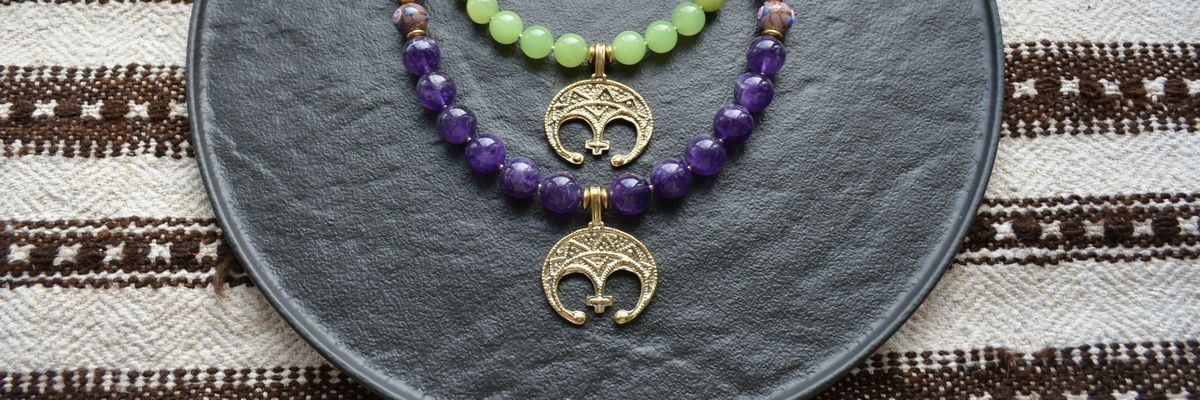
The lunnytsia — a crescent-shaped amulet pendant — was one of the most widespread women's pendants as far back as the era of Kyivan Rus. In the 8th–12th centuries it was worn by Slavic peoples across Europe, and through the marriages of Vikings to Slavic women, lunnytsias even reached Scandinavia.
The shape also hints at the name: "lunnytsia" comes from the moon (luna). The most common theory links the pendant to the cyclical nature of the moon, echoing the nature of woman, since ancient goddesses who protected women often embodied the moon itself. To be honest, no written sources from those times about lunnytsias have survived, so we speak of their meaning as a well-founded assumption rather than a proven fact.
For us, the lunnytsia is also evidence of Ukraine's European roots: these pendants are found across almost the entire territory of the country. By wearing one, we carry an ancient link of fashion forward and bring the memory of generations into the future.
Our lunnytsia necklaces
We treat this pendant with particular respect, so in our work we use historical replicas and authentic traditional forms — only such pieces are true lunnytsias. They are made by Ukrainian brass-casters and jewelers from brass, silver, bronze, and nickel silver.
Around the lunnytsia live natural stones, amber, pearls, coral, mother-of-pearl, and modern beads. Minimalist necklaces with the "flower of life" lunnytsia become an everyday amulet, while fuller ones with a larger lunnytsia add refinement to festive, ethnic, or wedding attire.
What matters most
We believe jewelry should be chosen not "to match a dress" but to match yourself — who you truly are. A lunnytsia necklace is for those who feel a bond with an ancient female tradition and who want to wear an amulet every day rather than save it for special occasions.
👉 Choose your lunnytsia necklace from the handmade SHTERNO collection. For questions about the stone, length, or timelines, message us on Instagram @shterno.etno.